
The committee responsible for monitoring progress on the Mass Casualty Commission recommendations has released its final annual report, concluding its three-year monitoring mandate. But while the committee’s work has ended, many of the initiatives it was tasked with monitoring have not.
Of the 130 recommendations put forward by the Mass Casualty Commission, the Progress Monitoring Committee (PMC) monitored 90, grouped into themes and sub-themes broadly aimed at advancing the joint commitment of the Nova Scotia and federal governments to improve public safety.
The findings don’t lend themselves particularly well to a statistical breakdown showing a neat completion rate.
Rather than assigning a final status to each of the 90 recommendations, the committee assessed progress across themes and sub-themes, using ratings ranging from “completed” and “on track” to “initiated.” Those assessments could encompass multiple recommendations and initiatives. A completed rating meant an action or initiative had been completed and met the “spirit and intent” of the MCC recommendation — not necessarily that its impact on public safety or community well-being could already be measured.
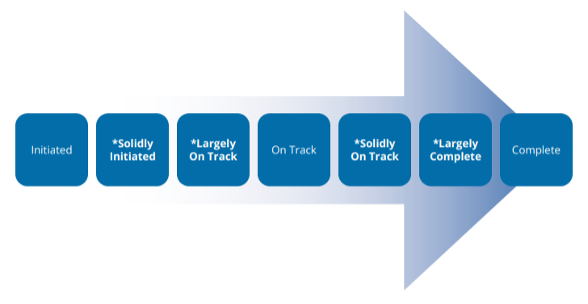
Source: Progress Monitoring Committee, Final Annual Report 2025–26
Some areas were considerably further along than others. The RCMP’s work on the sale and disposal of decommissioned police vehicles, for example, was rated complete. Progress involving broader systemic and cultural change was more difficult to assess.
As reported by the Halifax Examiner, PMC chair Myra Freeman said progress was difficult to assess in areas requiring broader systemic, cultural and societal changes, including misogyny, gender-based violence and institutional trust.
“[These] will require efforts extending well beyond our three-year mandate,” Freeman said.
A Trauma-informed Lens
Trauma-informed approaches became an increasingly central consideration in the PMC’s work. The committee highlighted areas where it saw those principles being incorporated, including community well-being work that recognized different communities have different needs and sought to “meet people where they are.”
Elsewhere, the committee wanted to see trauma-informed practices applied more deliberately. It called for further progress from the RCMP in taking a trauma-informed approach to recommendations concerning police uniforms and equipment, identifying the recovery of uniforms as one area where it could be particularly important. In its consideration of public alerting, members also emphasized the need to consider how emergency messages are received and experienced by members of the public.
That importance was also reflected in our conversation with PMC member, registered social worker and trauma therapist Kristina Fifield on the One Door podcast. Fifield described the importance of understanding trauma responses when people interact with institutions, noting that those responding may not always have the skills or tools to do so appropriately.
“What I often see and hear is that the individuals that were responding to them … were not in a place of presence,” she said, emphasizing the need for greater professional development, training and awareness.
Describing the approach taken when engaging survivors during the Mass Casualty Commission process, Fifield put the principle more simply: “We wanted to make sure that we were not causing more harm.”
The Work Extends Beyond the Committee
Some initiatives being undertaken in response to the MCC recommendations have timelines extending beyond the end of the PMC’s mandate. That includes initiatives categorized as “medium-term,” with target completion by March 2027, and “long-term” work extending beyond April 2027.
New initiatives also continue to emerge. In September, Nova Scotia announced that the Town of New Glasgow, the Region of Queens Municipality and the Municipality of East Hants, in partnership with Halifax Regional Municipality, had been selected to pilot new community safety and well-being plans. Public Safety Canada is contributing $550,000 to the initiative through its Guns and Gangs Violence Action Fund.
The plans are being developed by consultants, while a provincial advisory committee is still being established to guide the strategy and support participating municipalities.
The initiative responds directly to an MCC recommendation to move away from reactive, siloed responses to crime and harm toward co-ordinated efforts focused on prevention. The experience of the three pilot communities is intended to help shape an eventual provincewide strategy.
Formal monitoring beyond the end of the PMC’s mandate is less clear. Some committee members had called for the monitoring period to be extended, particularly given that some of the work will continue into 2027 and beyond.
“As our mandate concludes, I hope one lasting legacy of the committee will be recognition that independent oversight plays a vital role in maintaining momentum, ensuring transparency and holding governments and agencies accountable following a public inquiry,” Freeman said.
With the committee’s work now concluded, Freeman said it is “incumbent on all of us” to continue holding the governments of Nova Scotia and Canada and the RCMP accountable for continued progress. The Nova Scotia government has said it accepts responsibility for carrying the work forward, but no successor independent monitoring body has been announced.